
Upper Svaneti (Mestia)
Georgia
Eastern Europe · Best time: Mid-September to mid-October (the pick); July-August (peak); Early June to early July
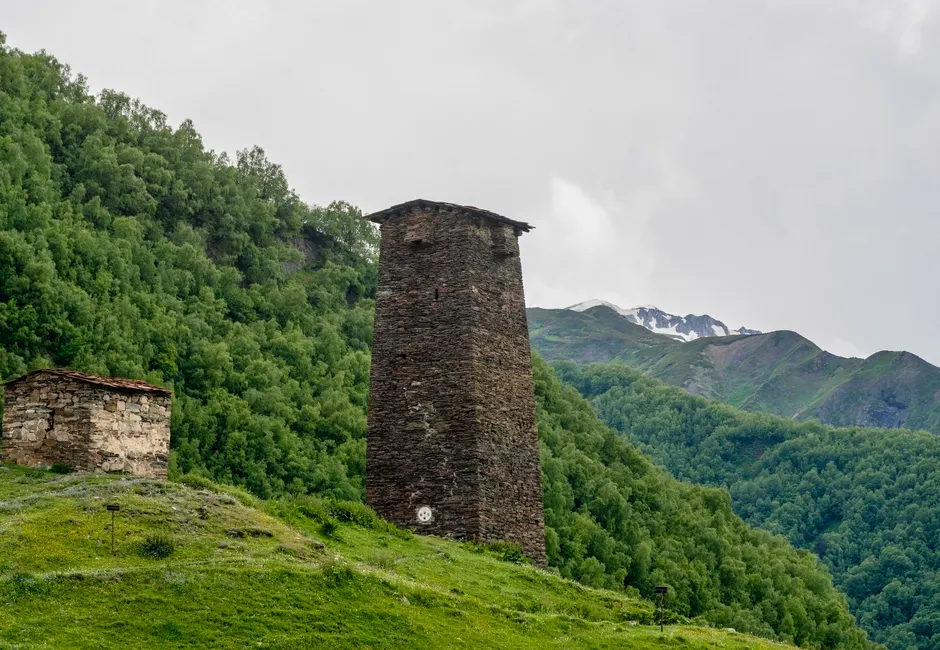
On the third day of the walk from Mestia to Ushguli you have to cross the Adishi river, and there is still no bridge. It runs off a glacier, so it is low at dawn and rises through the day as the ice melts above you - which means the crossing is not a place, it is a time. Arrive by mid-morning and it is thigh-deep and very cold. Arrive at four in the afternoon in June and it is genuinely dangerous. Men from the village wait on the bank with horses and carry you over for 20 to 30 lari. Everything about Svaneti is in that river: the mountains do not stop you, but they do set the hours.
Mestia is the base for all of it - a town of about two thousand people under Ushba, with two museums, an airport and a ski lift, and the trailhead for everything in this dossier. Upper Svaneti around it is the high southern flank of the Greater Caucasus, and what makes it look unlike anywhere else are the towers. Three to five storeys of dressed stone, walls tapering as they rise, machicolated parapets at the top for dropping things on people, attached to a two-floor dwelling where the ground floor was a single hall with an open hearth shared with the animals. ICOMOS dates them from the early ninth century to the seventeenth, with the creative peak in the tenth to twelfth. A survey in 1983-85 counted 208 of them still standing across the region, along with 196 churches and 342 dwelling complexes.
Ushba, the twin-summited peak above the town, is what climbers call the Matterhorn of the Caucasus and generally regard as the hardest ascent in the range. Forty-eight kilometres east up the valley is Ushguli, a cluster of hamlets under Shkhara, Georgia's highest point, where the church of Lamaria stands on a ridge above the houses. It is ninth or tenth century, dedicated to the Dormition, and its name fuses the Virgin Mary with Lamaria, a pre-Christian fertility deity the Svans never quite gave up.
The thing almost nobody writes about sits in a case in the Mestia museum. The Adishi Gospels were written in 897 at Shatberdi monastery in Klarjeti by a scribe named Mikaeli, carried into the mountains, and kept in the village of Adishi for roughly a thousand years. It is the oldest dated surviving manuscript of the Georgian gospels. Adishi is the village on day three - the one where the trekkers queue for a horse.
Why It's Unbeaten
Set the expectation honestly, because this is the least hidden place we have written about. Mestia has a working airport with scheduled flights. It has two ski resorts. It was named a UNWTO Best Tourism Village in 2022. The Mestia-Ushguli trail is the most-walked mountain route in Georgia, and in July and August it carries something like 100 to 150 people a day. Anyone who tells you the trails here stay empty has not been in August.
What is true is the scale and the shape of the year. In 2023, Mestia and its surroundings took 77,143 visitors - against 432,798 at Stepantsminda/Kazbegi, Georgia's other flagship mountain town. That is under a fifth. And Samegrelo-Upper Svaneti records the lowest share of international leisure trips of any region in Georgia. The airport moves under ten thousand passengers a year, about one visitor in eight; everyone else comes up the road from Zugdidi.
So the mountains are not unknown. They are compressed. Practically all of that traffic lands between late June and early September, on one trail, in a region with more than two hundred surviving medieval towers spread across dozens of valleys. Walk the same route in the third week of September and the guesthouses have space, the rivers are at their lowest all year, and the towers are yours. Go in October and you will have the light and almost nobody else. The window is real. The obscurity is not, and we would rather say so.
The Reward
Medieval stone towers over a valley where the language has no written form and the river you must cross has no bridge.
Visit instead of: The Tour du Mont Blanc — The same guesthouse-to-guesthouse rhythm with a fraction of the booking system, at a third of the price, in a language nobody has written down.
Ideal For
First-time multi-day trekkers who want guesthouses not tents, Walkers who would rather book nothing, Heritage and manuscript people, Anyone who will come in September instead of August
Not Ideal For
Anyone who needs a confirmed itinerary, Nervous river-crossers, Winter visitors without mountain experience, Travellers wanting luxury or fine dining, Anyone hoping to have the main trail to themselves in August
Recommended Stay
Lower Svaneti (Lentekhi)
Georgia
Caucasus · Best time: July-August (the reliable window); June and September-October (the pick); November-May

There are two Svanetis, and almost everyone has only heard of one. Upper Svaneti is the Enguri valley - Mestia, Ushguli, the World Heritage inscription, the airport, the ski lifts, a hundred and fifty walkers a day on the trail in August. Lower Svaneti is over the ridge to the south, in the Tskhenistsqali valley, and it has the same language, the same tower-building tradition and none of the traffic. Lentekhi has four hotels. Mestia has a hundred and seventy-eight.
The two are separated by the Svaneti Range - eighty-five kilometres of it, topping out at Mount Laila at 4,009 metres - and joined by exactly one road, over the Zagari Pass at around 2,620 metres. It opens somewhere around late May and closes in October under two or three metres of snow. For the rest of the year Lower Svaneti faces the other way entirely, down the Tskhenistsqali to Tsageri and Kutaisi, which is why it feels less like the back of Upper Svaneti and more like a separate country that happens to share a language.
Lentekhi Municipality is 1,344 square kilometres, sixty villages, and a town of under a thousand people at 760 metres. The land runs from 450 metres up to Ailama at 4,547 on the main Caucasus watershed; sixty-four per cent of it is forest, and ninety-two per cent of its farmland is pasture, because crops stop growing above nine hundred metres. Eighty-three per cent of the settlements have fewer than two hundred people in them. The largest village, Kheledi, has 258.
What it does not have is a UNESCO plaque, a protected area, a tour operator, or a single attraction listed on TripAdvisor. What it does have is the Zagari road, a three-day trek east into Racha that nobody maintains, a fourteenth-generation dialect nobody has written down, and - genuinely - a hundred thousand tonnes of Soviet arsenic waste sitting in a village by the river.
Why It's Unbeaten
The statistics are almost comic. Lentekhi Municipality has four hotels against Mestia's hundred and seventy-eight. The whole Racha-Lechkhumi and Kvemo Svaneti region - Georgia's least populated, 28,500 people in 2021 - carries 304 TripAdvisor attraction reviews in total, and not one of the listed attractions is in Lower Svaneti; they are all on the Racha side. TripAdvisor's own Lentekhi page fills itself with Mestia content, because there is nothing local to list. Geostat does not even publish visitor figures for the region on its own: it folds it into Imereti, because it is too small to count.
The reason is the ridge. Upper Svaneti has an airport, a ski resort and a road from Zugdidi that is ploughed all winter. Lower Svaneti has one seasonal pass to the north and a long valley road to the south, and everyone who comes to Georgia for mountains goes to the other one. The Transcaucasian Trail's published Georgian sections do not enter here at all - though its crews were flagging new route through the Tskhenistsqali in 2024, which is the first sign in decades that this may not stay true.
And there is the emptying. The municipality lost 37 per cent of its people between the 2002 and 2014 censuses, from 6,984 to 4,386. Forty-eight babies were born in the entire district in 2020. Villages named Bavari, Benieri, Buleshi, Mananuri and Kheria have between two and eleven permanent residents each. Whole schools and kindergartens have closed.
The honest twist is that the 2024 census recorded Lentekhi Municipality growing by 17.5 per cent - one of the largest increases in Georgia, in a region that fell by nearly seven per cent. Whether that is people returning or people registering to claim the mountain-residency benefits introduced in 2015, nobody has established. Either way it is the most interesting demographic number in the country, and nobody is writing about it.
The Reward
The other Svaneti - same language, same towers, no UNESCO plaque, and a road over the mountain that opens for five months a year.
Visit instead of: Mestia and Upper Svaneti — The same language and the same tower-building tradition on the other side of one ridge - and four hotels against Mestia's hundred and seventy-eight.
Ideal For
Trekkers happy on unmaintained routes, Anyone who has done Mestia-Ushguli and wants the other side, Linguists and people who care about dying languages, Wine travellers heading for Lechkhumi, Travellers who will ring a stranger to ask if a road is open
Not Ideal For
Anyone who needs a booked itinerary, First-time Caucasus visitors, Travellers without their own transport or patience for one marshrutka a day, People expecting the Ushguli skyline, Anyone travelling outside June to October who wants the mountains
Recommended Stay
Loading...