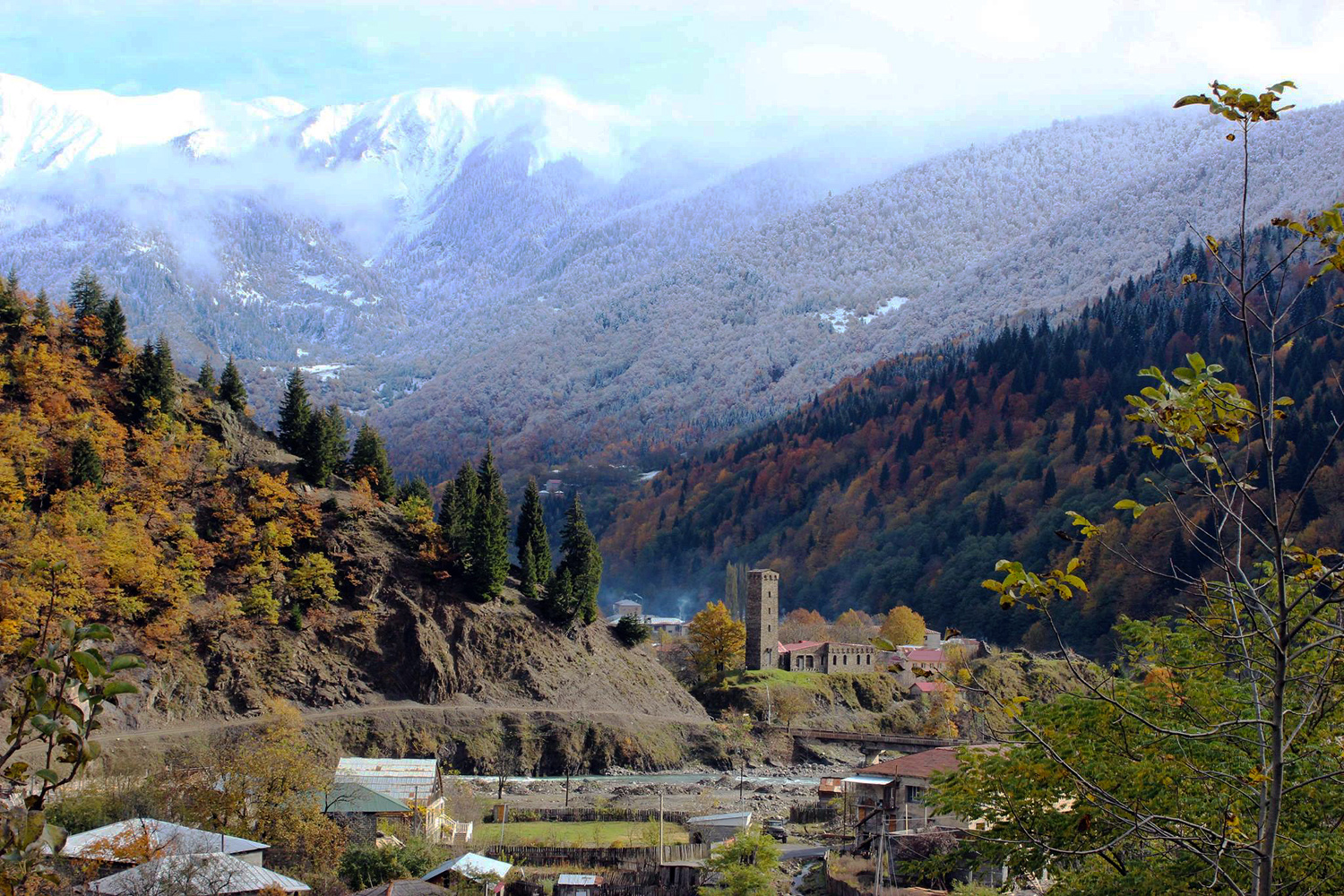
There are two Svanetis, and almost everyone has only heard of one.
Upper Svaneti is the Enguri valley — Mestia, Ushguli, the World Heritage inscription, the airport, the ski lifts, a hundred and fifty walkers a day on the trail in August. Lower Svaneti is over the ridge to the south, in the Tskhenistsqali valley, and it has the same language, the same tower-building tradition and none of the traffic. Lentekhi has four hotels. Mestia has a hundred and seventy-eight.
The two are separated by the Svaneti Range — eighty-five kilometres of it, topping out at Mount Laila at 4,009 metres — and joined by exactly one road, over the Zagari Pass at around 2,620 metres. It opens somewhere around late May and closes in October under two or three metres of snow. For the rest of the year Lower Svaneti faces the other way entirely, down the Tskhenistsqali to Tsageri and Kutaisi, which is why it feels less like the back of Upper Svaneti and more like a separate country that happens to share a language.
Lentekhi Municipality is 1,344 square kilometres, sixty villages, and a town of under a thousand people at 760 metres. The land runs from 450 metres up to Ailama at 4,547 on the main Caucasus watershed; sixty-four per cent of it is forest, and ninety-two per cent of its farmland is pasture, because crops stop growing above nine hundred metres. Eighty-three per cent of the settlements have fewer than two hundred people in them. The largest village, Kheledi, has 258.
What it does not have is a UNESCO plaque, a protected area, a tour operator, or a single attraction listed on TripAdvisor. What it does have is the Zagari road, a three-day trek east into Racha that nobody maintains, a fourteenth-generation dialect nobody has written down, and — genuinely — a hundred thousand tonnes of Soviet arsenic waste sitting in a village by the river.
Photo by Karel61 on Wikimedia Commons
Why it's Unbeaten
Out of the main current, in the right way.
The statistics are almost comic. Lentekhi Municipality has four hotels against Mestia's hundred and seventy-eight. The whole Racha-Lechkhumi and Kvemo Svaneti region — Georgia's least populated, 28,500 people in 2021 — carries 304 TripAdvisor attraction reviews in total, and not one of the listed attractions is in Lower Svaneti; they are all on the Racha side. TripAdvisor's own Lentekhi page fills itself with Mestia content, because there is nothing local to list. Geostat does not even publish visitor figures for the region on its own: it folds it into Imereti, because it is too small to count.
The reason is the ridge. Upper Svaneti has an airport, a ski resort and a road from Zugdidi that is ploughed all winter. Lower Svaneti has one seasonal pass to the north and a long valley road to the south, and everyone who comes to Georgia for mountains goes to the other one. The Transcaucasian Trail's published Georgian sections do not enter here at all — though its crews were flagging new route through the Tskhenistsqali in 2024, which is the first sign in decades that this may not stay true.
And there is the emptying. The municipality lost 37 per cent of its people between the 2002 and 2014 censuses, from 6,984 to 4,386. Forty-eight babies were born in the entire district in 2020. Villages named Bavari, Benieri, Buleshi, Mananuri and Kheria have between two and eleven permanent residents each. Whole schools and kindergartens have closed.
The honest twist is that the 2024 census recorded Lentekhi Municipality growing by 17.5 per cent — one of the largest increases in Georgia, in a region that fell by nearly seven per cent. Whether that is people returning or people registering to claim the mountain-residency benefits introduced in 2015, nobody has established. Either way it is the most interesting demographic number in the country, and nobody is writing about it.
The main event
What you'll actually do in and around Lower Svaneti (Lentekhi)
01
Drive or walk the Zagari Pass
The only road link between Upper and Lower Svaneti, at roughly 2,620 metres — sources give figures from 2,619 to 2,642 and none is authoritative. Ushguli down to Mele via Tsana is about 37.5 km, walkable in two days and better in three, on what has historically been a jeep track. Recent accounts say it has been hard-surfaced with gravel only through the landslide zones, and that 4WD is no longer essential in summer; older accounts and Georgian reporting say off-road vehicles only. Ask in Ushguli or Lentekhi before you commit a hire car.
02
Trek Zeskho to Ghebi, over into Racha
The serious walk here and the one the national tourism body actually publishes: 43 km over three days from Zeskho, across the Lapuri Pass at 2,526 metres and past the Sasvano Lakes, topping out around 2,900 m at the Vatsistveri Pass, and down into Ghebi in Racha. Rated difficult. The specialist trekking reference warns it is unmaintained and that you will be finding your own way through an overgrown valley — treat it as a route, not a trail.
03
Cross the Latpari Pass from Ushguli
The walkers' alternative to the Zagari road: 22.5 km from Ushguli down to Chvelpi in Lentekhi Municipality, one to two days, via the Gorvashi Pass at 2,917 metres. July to September. This is how you arrive in Lower Svaneti on foot from the famous side.
04
The Oniani tower and machubi at Chukuli
The one piece of Lower Svaneti's built heritage with a documented, dated protection order: a four-storey slate tower and a two-storey machub dwelling carved with geometric ornament, granted immovable cultural monument status on 6 December 2017. Lower Svaneti has towers — just far fewer than Upper Svaneti, and nobody has ever counted them.
05
The village churches
The national tourism body names seven: Tvibi Archangel, Mami Church of the Savior, Chikhareshi Mother of God, Skaldi Church of the Archangels, Paki Mother of God, Chukuli Archangel and Jakhunderi St George. It gives no dates for any of them, and the dates circulating elsewhere are uncited. Go and look; nobody has done the work for you.
06
Lentekhi town: the Dadiani complex and the museum
The fortified Dadiani palace complex and the Lentekhi Local Lore Museum, which holds Bronze Age archaeology, religious objects of the 11th and 12th centuries and manuscripts from the 17th and 18th. Whether the museum is currently open could not be established remotely — ask at your guesthouse.
07
Waterfalls at Natbeura and Imindari
The local action group lists Natbeura as the highest waterfall in Lower Svaneti, an easy three-hour walk, and Imindari as an easy family option. These are the only short walks anyone has documented properly here.
08
Look at Tsana, and understand what you are looking at
A near-abandoned village on the Zagari road with medieval churches and tower houses that get almost no visitors — and around 100,000 tonnes of arsenic-bearing waste from Soviet metallurgical plants that closed in the 1990s, drums still scattered openly on the site. In September 2013 flooding shifted the riverbed and damaged the old dam, causing leakage; laboratory analysis found river concentrations within permissible limits. Remediation has been announced. Whether it has happened is unverified. Do not go poking about in the drums.
Taste of Lower Svaneti (Lentekhi)
Where to eat
There is no restaurant scene. You eat at your guesthouse, and half board is the normal arrangement — 40 to 50 lari at Tsana, for instance, against 20 for the bed alone.
The food is Svan, the same tradition as over the ridge, and it comes out of an economy that is overwhelmingly livestock: pastures and hay are 92.4 per cent of the agricultural land here, crops stop growing above nine hundred metres, and the municipality counts 230 beekeepers with 1,800 hives. So: meat, dairy, potatoes, bread and honey, cooked by whoever you are staying with.
KubdariBread dough filled with hand-chopped spiced meat and baked. The Svan dish on both sides of the range.
Svanuri mariliSvan salt — ground with coriander, blue fenugreek, dried marigold, garlic and chilli. On every table and in most of the cooking.
Local honeyWith 230 beekeepers across a municipality of a few thousand people, this is a serious local product rather than a souvenir. Buy it at the door.
Half board at your guesthouseNot a recommendation, a description of the only reliable option. Arrange it when you book rather than arriving hungry.
02 / The honest read
Is Lower Svaneti (Lentekhi) your kind of trip?
Best for
+ Trekkers happy on unmaintained routes
+ Anyone who has done Mestia-Ushguli and wants the other side
+ Linguists and people who care about dying languages
+ Wine travellers heading for Lechkhumi
+ Travellers who will ring a stranger to ask if a road is open
Think twice if you want
x Anyone who needs a booked itinerary
x First-time Caucasus visitors
x Travellers without their own transport or patience for one marshrutka a day
x People expecting the Ushguli skyline
x Anyone travelling outside June to October who wants the mountains
Effort and reward
Planning
5/5
Physical effort
4/5
Self-reliance
5/5
Scenery
4/5
Culture
4/5
Difficulty breakdown
What "7/10" actually means
Language barrier8/10
No English, and the question you most need answered — is the pass open — can only be asked in Georgian.
Logistics8/10
One seasonal pass whose dates nobody publishes, a landslide-prone valley road, no operators, no scheduled transport over the mountain, and no way to book most of the beds.
Physical demand6/10
The good walking is multi-day and unmaintained — 43 km over three days to Ghebi across two passes, or a full day over Latpari from Ushguli.
Infrastructure2/10
Four hotels in the whole municipality, no verified ATM, fuel station, pharmacy or rescue service, and three villages with no winter road at all.
Getting to Lentekhi is easy — asphalt and a marshrutka from Kutaisi in under two hours. Everything after that is hard, and hard in a way that no amount of planning from home resolves, because the two facts that govern your trip are whether the Zagari Pass is open and whether the Saqdari bridge is standing, and both are answered by ringing somebody in the valley.
Read this before booking
The honest caveats
The single road over the mountain is fragile, and recently proved it. On 28 and 29 August 2026 heavy rain triggered a landslide that destroyed the road bridge near Saqdari and closed the Lentekhi-Mestia direction to all vehicles; a temporary bridge opened on the 30th, with a permanent replacement at tender. Check the status of that crossing before you build an itinerary around it, because this corridor closes more often than any guide admits.
The trails are not maintained and the good one is barely a trail. The Zeskho-Ghebi route is published by the national tourism body and rated difficult, and the specialist trekking source says plainly that it is unmaintained and you will be finding your own way through an overgrown valley. Five further trails appear by name on the government tourism page — Lentekhi-Matskhvarishi, Mananuri-Tviberi, Khacheshi-Doberazeni, Shkedi-Likheti, Sasashi-Lashichala — with no distances, no waymarking and no trip reports anywhere. Treat those as names on a website, not as routes.
There is no tourism industry to catch you. Every operator working 'Svaneti' means Mestia. We could not verify that Lentekhi has an ATM, a fuel station, a pharmacy or any dedicated mountain rescue cover; the national emergency number is 112 and the nearest real hospital is a long way down the valley. There is no commercial guiding here — arrangements go through guesthouses and the local action group.
And be clear about the towers. Lower Svaneti has them, but far fewer than Upper Svaneti, and nobody has ever published a count. If you are coming for the Ushguli skyline you will be disappointed; if you are coming because Ushguli had four hundred people on it and you wanted the same culture without them, you have come to the right valley.
Safety & health
Georgia is a low-crime country and this is one of its emptiest corners; nobody is going to bother you. Every real risk here is about distance and weather.
Understand the road. The corridor between Lentekhi and Upper Svaneti is landslide-prone and was severed at Saqdari by a washed-out bridge in late August 2026; the valley road up from Tsageri has flooded and closed before. The Zagari Pass carries two to three metres of snow in winter and the villages of Tsana, Zeskho and Koruldashi have no winter road access at all. Between 1988 and 1991 avalanches and landslides left dozens of Lentekhi families homeless.
Understand the isolation. We could not verify that Lower Svaneti has any dedicated mountain rescue service, a hospital, a pharmacy, a fuel station or an ATM; the national emergency number is 112 and help will come from a long way off. Mobile coverage is unverified. On the Zeskho-Ghebi route you are on an unmaintained path in an uninhabited valley — leave your plan with your guesthouse and carry a satellite messenger if you have one.
One specific hazard, and it is unusual. Around 100,000 tonnes of arsenic-bearing waste from Soviet-era metallurgical plants sits at Tsana, with drums reported scattered openly on the site. Flooding in 2013 damaged the containment and caused leakage, though river concentrations tested within permissible limits at the time. Remediation has been announced but not confirmed. Do not camp on the site, do not handle anything, and do not drink from the river immediately below it.
Otherwise, standard Caucasus precautions. Travel insurance with mountain rescue and repatriation cover is essential and, since January 2026, insurance is a legal condition of entry. Ticks are present in long grass. Shepherd dogs guard flocks and will come at you.
Official advisoryLevel 1
Georgia is a Level 1 destination. Lower Svaneti is among its emptiest and safest corners; the real risks are landslides, snow, isolation and one derelict arsenic site.
Advisories change. Verify with the US State Department before travelling. Last reviewed: 2026.
03 / Make it real
Plan the trip
July-August (the reliable window)
Why go: The pass is open, the high passes on the Zeskho-Ghebi route are clear, and the side valleys to Zeskho and Koruldashi are reachable. Lentekhi averages 9.4C annually with 189 frost-free days, so summer here is comfortable rather than hot.
Watch for: Also when the Tskhenistsqali valley is at its most overgrown — the trekking reference specifically warns about pushing through it. And the little accommodation there is can fill with the handful of people who do come.
June and September-October (the pick)
Why go: The pass is usually open at both ends of this and the walking is better. September is the sweet spot: rivers low, the valley less overgrown, and beech and chestnut turning across sixty-four per cent forest cover.
Watch for: The pass opening and closing dates move by weeks from year to year, and nobody publishes them. Ask locally, and have a plan that does not require the crossing.
November-May
Why go: Lentekhi town stays reachable on the asphalt from Kutaisi, and the valley in snow with almost nobody in it is a real thing.
Watch for: The Zagari Pass is shut. Tsana, Zeskho and Koruldashi have no winter road access at all. Koruldashi, at 1,943 metres, has 170 snow days a year. This is not a season for the mountain side of the destination.
Getting there
Getting there
Kutaisi is the gateway, not Zugdidi. The national tourism body gives Kutaisi to Lentekhi as 1 hour 50 minutes; Batumi is 4 hours and Tbilisi 5 hours 40, at 323 km. The corridor runs Kutaisi and the Tsqaltubo bypass, then Tsageri, then up the Tskhenistsqali.
The road is asphalt, and recently so. A 24-kilometre rehabilitation through Chvelieri, Tekali, Leusheri, Panaga, Sasashi, Lemzagori, Jakhunderi, Mele and Benieri laid asphalt-concrete, renovated the bridges and built one new one, at a cost of 19,683,383 lari from the state budget. Before that programme began in 2017, the road had had no rehabilitation since 1985.
By marshrutka, one source gives Kutaisi to Lentekhi at 8 lari, departing 09:00, 14:00 and 16:00 from the main bus station on Chavchavadze — treat the fare and times as indicative and check locally, because it is a single undated listing. From the Zagari side, a morning marshrutka is reported from Mele down to Lentekhi and Kutaisi, or a taxi for a group at around 120 lari.
The Zagari Pass is the other way in, from Ushguli, and it is a different proposition entirely — see below. There is no scheduled transport of any kind over it.
Visa & entry
Entry requirements
Georgia is among the easiest countries in the world to enter. Citizens of more than 90 countries — including the US, UK, all EU states, Canada, Australia and New Zealand — enter visa-free for up to 365 days on a valid passport. Holders of a valid Schengen, US, UK, Canadian, Australian, New Zealand or GCC visa or residence permit may enter visa-free for 90 days regardless of nationality. Everyone else applies for an e-Visa at evisa.gov.ge, normally issued in five to ten working days.
Since 1 January 2026 all tourists must hold valid health and accident insurance for the whole stay, with minimum cover of 30,000 GEL — roughly $11,000, not EUR 30,000, a figure that circulates widely and wrongly. Carry it on paper or on screen, in Georgian or English.
There is no permit of any kind for Lower Svaneti. Georgia requires border-zone permits for some Caucasus areas — Truso beyond Zakagori, Vashlovani, and the Mamisoni and Notsara passes — and Lentekhi Municipality is not among them, despite sharing a watershed with Russia. No trekking permit is needed for the Zagari or Latpari crossings.
PassportRequirementMax stayDetails
USVisa-free365 daysValid passport only. Health and accident insurance with minimum cover of 30,000 GEL mandatory from 1 January 2026. Official portal
UKVisa-free365 daysAs above. No border-zone permit is required for Lentekhi Municipality. Official portal
EUVisa-free365 daysValid passport or, for some states, national ID. 30,000 GEL insurance mandatory from 1 January 2026. Official portal
Requirements may change. Confirm with the relevant embassy or official immigration authority before booking.
Daily budget
What it costs once you're there
Excluding flights / Georgian Lari (GEL) / 1 USD = 2.61 GEL (2026-09-07)
Budget$35A village guesthouse with half board at around 40-50 lari, the marshrutka up from Kutaisi, and very little else to spend money on. Camping at Tsana brings it lower.
Midrange$80Guest House Svaneti in Lentekhi at around $45, a hire car or a shared taxi, and a driver for the Zagari crossing rather than waiting for a lift.
Base yourself well
Where to stay
Search live availability
Use the curated stays below as a starting point, then compare current inventory and prices.
Six rooms a kilometre from the town centre, shared kitchen, Wi-Fi and a garden. Rated 8.7 out of 10 from 29 reviews, which makes it the most reviewed thing in Lower Svaneti by a distance.
Village guesthouse20 GEL bed only; 40-50 GEL half board
Guesthouse Tsana
A two-storey wooden house in Tsana, on the Zagari road, with hot water, a kitchen, a fireplace and views to Shkhara. Camping is possible here too. The obvious stop if you are crossing the pass over two days.
Village guesthouseNegotiated locally
Rati's guesthouse, Mele
The first inhabited village on the descent from the pass, with drinks and home cooking. The place you are very glad to see after a long day off the mountain.
GuesthouseUnpublished
Guesthouse Lentekhi
Listed on TripAdvisor with no published rate. Between this and Guest House Svaneti you have most of the town's formal inventory — the whole of Lentekhi carries six hotel reviews in total.
Local booking contactn/a
Lentekhi Local Action Group
The EU-supported body developing tourism here. If you cannot find a bed online, this is the number to ring — they know who is taking guests and which trails are walkable.
Language, useful phrases, and cultural notes +
Georgian (Lower Svan spoken locally) / English: None
No English spoken - locals unlikely to understand any English. Translation device is essential
The language is the reason to pay attention here. Svan is a separate Kartvelian language, not a Georgian dialect, and it splits into two branches: Upper Svan, spoken in the Enguri valley, and Lower Svan — the Lashkh, Lentekhian and Cholurian dialects — spoken along the Tskhenistsqali. As of 1997 there were fewer than 12,000 Lower Svan speakers against about 15,000 Upper Svan, all bilingual in Georgian, and researchers were already predicting a radical dissolution of the speech community through emigration. The music has gone further than the language: a 2004 field expedition by the Tbilisi Conservatoire's polyphony centre visited Kakhura, Tekali, Khopuri, Tsana and Kheledi and found most performers had lost contact with their own tradition, singing repertoire from other parts of Georgia — though it did record Lower Svan variants of Tsmindao Ghmerto and Alilo, and chuniri playing. Historically Lower Svaneti was ruled by the Princes Gelovani before being absorbed by the Dadiani of Mingrelia, which is why it is sometimes called Dadiani Svaneti; the principality was abolished in 1858. Practically: assume no English, download Georgian for offline translation, accept food and toasts, ask before photographing anyone, and take your shoes off indoors.
Helloგამარჯობა (Gamarjoba)gah-mar-JO-ba
Thank youგმადლობთ (Gmadlobt)g-MAD-lobt
Excuse me / sorryუკაცრავად (Ukatsravad)oo-KATS-ra-vad
Is the pass open?უღელტეხილი ღიაა?oo-ghel-te-KHI-li GHI-aa
Where is...?სად არის...? (Sad aris...?)sad AH-ris
How much is it?რა ღირს? (Ra ghirs?)ra GHEERS
04 / Keep going
Nearby & beyond
Over the Zagari Pass — about 46-70 km depending on the source, 2-2.5 hours when open
Ushguli and Upper Svaneti
The famous half of Svaneti, and the only way to appreciate what Lower Svaneti is missing and what it has instead. The pass is open roughly June to October.
Down the Tskhenistsqali toward Kutaisi
Tsageri and the Lechkhumi vineyards
Home of Usakhelouri, one of the rarest wines in Georgia, made in tiny quantities in the Zubi-Okureshi zone, and of Tvishi, a naturally semi-sweet Tsolikouri white. There are no commercial tasting rooms — visits are arranged through guesthouses at family houses, which is the whole point.
Near Tsageri
Muri Fortress
The guardian and political centre of the province from antiquity until 1867, with three named towers, a monastery by the western tower, and the grave of St Maximus the Confessor, who died here in the seventh century.
East, and reachable on foot from Zeskho over the Lapuri Pass in three days
Racha: Ambrolauri and Oni
The neighbouring wine and mountain region, with Khvanchkara, the Nikortsminda cathedral, the Oni synagogue and an airport at Ambrolauri since 2017.
1 hour 50 minutes
Kutaisi
The gateway city and international airport, with the UNESCO-listed Gelati Monastery, the Bagrati cathedral and the Prometheus caves.