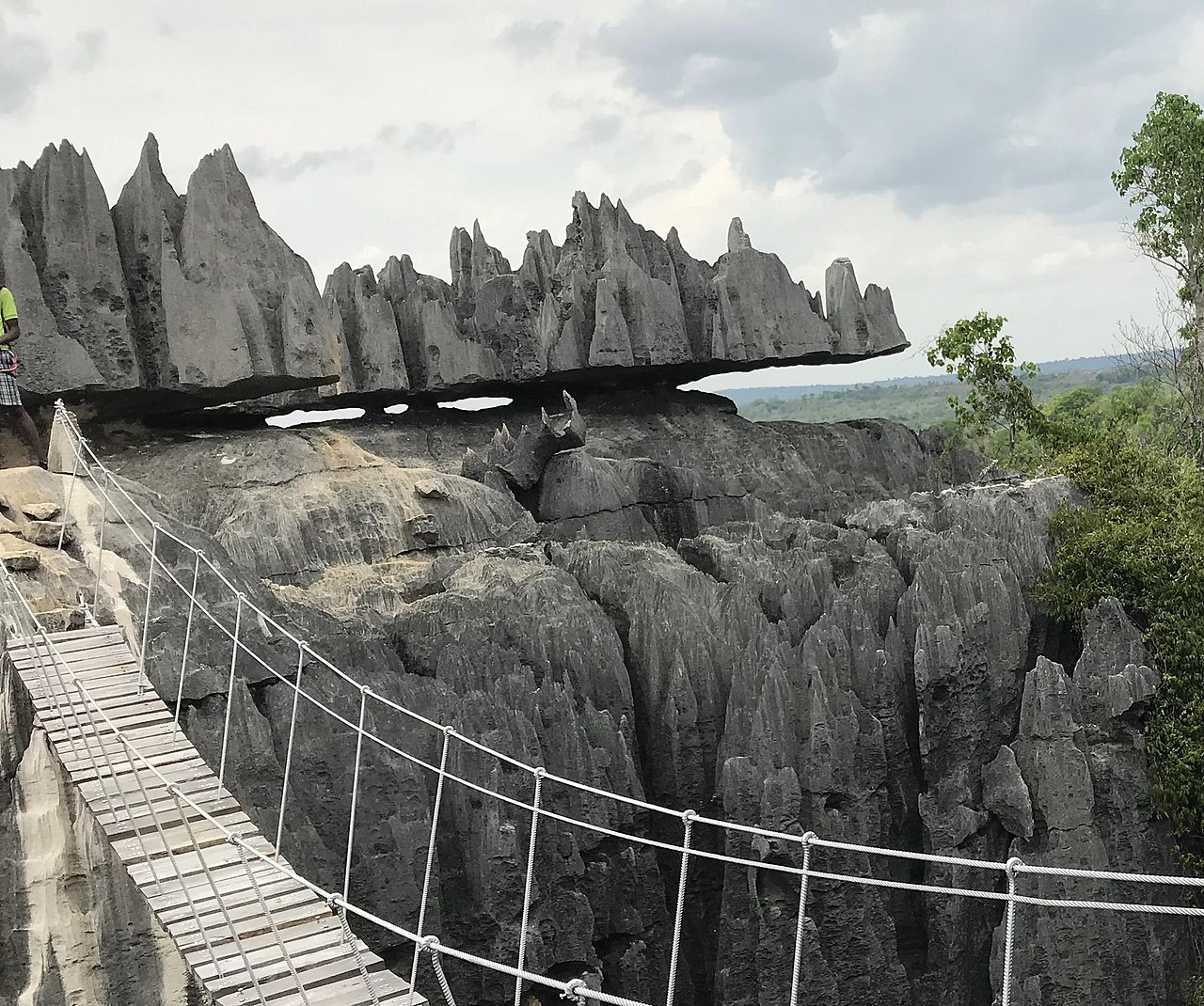
Tsingy de Bemaraha rises from western Madagascar like a fortress carved by time itself—a 600-square-kilometer labyrinth of limestone needles so sharp the Malagasy word 'tsingy' translates to 'where one cannot walk barefoot.' This UNESCO World Heritage site delivers on its promise of genuine remoteness: reaching it requires a bone-rattling 200-kilometer journey from Morondava, including a river crossing by ferry that operates on no particular schedule.
The reward is a landscape that appears designed by an alien architect—cathedral-like canyons with walls soaring 70 meters high, razor-sharp pinnacles forming natural bridges, and suspended forests growing impossibly from vertical rock faces where eleven species of lemur, including the rare Decken's sifaka, leap between stone spires.
The park's two sectors offer distinct experiences that justify the arduous approach. Petits Tsingy serves as an introduction—via ferrata routes thread through the formations using fixed cables and ladders, bringing you face-to-face with Madagascar's endemic chameleons hunting among the pinnacles. Grands Tsingy escalates the adventure: the Andadoany circuit involves genuine rock climbing through vertical fissures, crawling through stone tunnels barely wider than your shoulders, and crossing suspension bridges 20 meters above the forest canopy. Stand on the belvedere platform at sunrise and watch Verreaux's sifakas perform their sideways 'dancing' leaps across the Manambolo River gorge below—a sight that exists nowhere else on Earth.
The isolation that protects Tsingy from crowds also demands commitment. The village of Bekopaka, your base camp, offers basic lodges where dinner means zebu stew and rice served by kerosene lamp during frequent power outages. Guides like Jean-Claude from Madagascar National Parks aren't optional—they're essential for navigating routes where a wrong turn could mean genuine danger among the unforgiving rock formations. Visit between April and November when roads are passable; the wet season turns access routes into impassable mud rivers. Travelers who make the pilgrimage understand they've earned something: a landscape so inhospitable to casual tourism that your presence there feels like a privilege rather than a transaction.
Photo by Cactus0625 on Wikimedia Commons
Why it's Unbeaten
Out of the main current, in the right way.
The brutal logistics create a natural filter. The 200-kilometer journey from Morondava takes 10-12 hours in dry season, longer when rains turn the Route Nationale 8 into a mud-wrestling match for 4WDs. There's no paved road, no public transport, and the last 80 kilometers average 15 kilometers per hour over rocks that would disable a standard sedan in minutes. The park itself demands physical fitness—via ferrata circuits require genuine climbing over exposed drops, and temperatures inside the limestone labyrinth can hit 40°C. Add limited accommodation near the park, the need for mandatory guides, and Madagascar's general reputation for challenging travel infrastructure, and you've got a destination that weeds out anyone unwilling to earn their experience. The irony: this geological masterpiece sits in one of Earth's biodiversity hotspots, yet most travelers bail for the easier lemur-spotting near Antananarivo.
The main event
What you'll actually do in and around Tsingy de Bemaraha
01
The Grand Tsingy hike
This is the main event—a 3-4 hour scramble through the limestone labyrinth on metal ladders, chains, and natural rock steps. Your guide will navigate you through gaps barely wider than your shoulders, past spiky rock formations that'll shred your clothes if you're careless. It's technically moderate but psychologically intense; the views are genuinely otherworldly, like walking through a petrified forest of blades.
02
Petit Tsingy canyon walk
A gentler introduction to the formations—30-45 minutes of walking through a canyon with water pools and smaller tsingy needles. Go early morning when light filters through the formations and the air is cool. It's less crowded than Grand Tsingy and gives you a real sense of scale without the technical climbing.
03
Andavadoaka viewpoint and sunset
A short drive from the main camp leads to this overlooking point where you can see the entire Tsingy plateau unfold beneath you. Time it for late afternoon, bring water and a good camera, and watch the limestone turn golden as the sun drops. It's quiet, contemplative, and reminds you how vast this place really is.
04
Lemur spotting at Ankarafantsika Forest
Many tour operators combine Tsingy with this nearby reserve where you can spot Coquerel's sifakas, brown lemurs, and if you're lucky, fossas. Early morning guided walks through the dry deciduous forest yield reliable wildlife sightings without the crowds you'd find elsewhere in Madagascar.
05
Mangrove kayaking near Bekopaka
If you're staying near Bekopaka, arrange a kayak trip through the tidal mangroves where you might spot crocodiles, fish eagles, and wading birds. It's a calming contrast to the intensity of hiking the tsingy, and paddling through the roots at sunset is genuinely peaceful.
06
Night walk with your guide
After dark, nocturnal species emerge—chameleons, geckos, and insects. Your guide will have a headlamp and knowledge of where to look. It's eerie and wonderful in equal measure, and you'll understand the ecosystem in a completely different way.
Taste of Tsingy de Bemaraha
Where to eat
Food at Tsingy isn't about culinary sophistication—it's about fuel and flavour with what's available in a remote area. Expect rice as the base for most meals, along with local vegetables, occasional zebu (Malagasy cattle) meat, and fish if you're near water. Your lodge will prepare simple but satisfying meals; let them know ahead of time if you have dietary restrictions. Fresh fruit—bananas, papayas, coconut—appears when in season. Bring snacks you love (energy bars, chocolate, dried fruit) because variety is limited.
Lodge meals (breakfast before hikes)Request porridge or rice with eggs, fruit, and coffee before you head out at dawn. You'll need calories for the hike. The lodges understand this and will prepare filling breakfasts if you mention your plans.
Zebu brochettes at campGrilled meat skewers are a staple in the evenings. Simple, smoky, and more flavourful than you'd expect. Eaten with rice and whatever vegetables the cook managed to source—it's honest food after a hard day of hiking.
Fresh coconut water from local vendorsIf you pass through Bekopaka village, stop at a roadside stand and ask for coconut water straight from the nut. It's refreshing, hydrating, and costs almost nothing. It's the local way to rehydrate in the heat.
02 / The honest read
Is Tsingy de Bemaraha your kind of trip?
Best for
+ Adventure seekers
+ Geology enthusiasts
+ Wildlife photographers
+ Experienced travelers
+ Rock climbers
Think twice if you want
x Young families
x Mobility-impaired travelers
x Those with fear of heights
x First-time Africa visitors
x Travelers seeking comfort
Effort and reward
Planning
4/5
Physical effort
4/5
Self-reliance
4/5
Scenery
5/5
Culture
3/5
Difficulty breakdown
What "8/10" actually means
Language barrier7/10
English is rarely spoken outside Antananarivo; French helps significantly, but in villages near Tsingy only Malagasy is understood — hiring a local guide who speaks English is highly recommended.
Logistics9/10
Reaching Tsingy requires a grueling 7-10 hour 4x4 journey on some of Africa's worst roads, with river crossings and no public transport — most travelers book organized tours or hire private vehicles.
Physical demand8/10
Navigating the Tsingy requires climbing vertical ladders, crossing cable bridges, squeezing through narrow crevices, and scrambling over razor-sharp limestone — a reasonable level of fitness and agility is essential.
Infrastructure3/10
Accommodation near the park is basic (simple bungalows, often without electricity or running water), roads are unpaved and frequently impassable in wet season, and there are no ATMs or medical facilities nearby.
Tsingy de Bemaraha is one of Madagascar's most challenging destinations to reach and explore. The combination of extremely difficult access roads (often requiring 2 days each way from Antananarivo), physically demanding terrain within the park, minimal infrastructure, and the need for specialized vehicles and guides makes this a destination strictly for experienced, adventurous travelers willing to accept significant discomfort and uncertainty.
Read this before booking
The honest caveats
Here's what won't be perfect: the security situation in Madagascar is genuinely concerning right now. There have been recent protests and reported crime increases, particularly after dark. Your tour operator and guides will mitigate this, but you need to accept that you're travelling to a place where the government has limited emergency services infrastructure. The drive to Tsingy is long, hot, and uncomfortable—expect dust, potholes, and a vehicle without air conditioning. The hiking is physically demanding and genuinely dangerous if you're not fit or careful; people have died here by ignoring guide warnings. The tsingy will cut you if you slip; wear sturdy shoes and long pants. Accommodation is basic—no hot showers, inconsistent power, limited privacy. If you need comfort and predictability, this isn't your place. Finally, Tsingy is expensive relative to what you're getting because everything has to be transported in, guides are mandatory, and the park charges fees. Budget wisely.
Safety & health
The US State Department currently advises travelers to 'Reconsider Travel' to Madagascar (Level 3) due to crime and civil unrest, particularly in urban areas. However, the Tsingy de Bemaraha region itself is remote and generally peaceful, with the main risks being related to the challenging terrain rather than crime. That said, armed robbery has been reported on rural roads, so traveling in convoy and avoiding night driving is strongly recommended.
Health precautions are critical for this remote destination. Malaria is endemic throughout Madagascar — prophylaxis is essential, and you should use insect repellent and sleep under treated nets. Yellow fever vaccination is required if arriving from an endemic country. Recommended vaccinations include hepatitis A and B, typhoid, and ensuring routine vaccinations are current. The nearest medical facilities are basic clinics in Morondava, several hours away; serious medical emergencies require evacuation to Antananarivo. Comprehensive travel insurance with medical evacuation coverage is absolutely essential.
The physical risks within Tsingy itself are significant — the razor-sharp limestone formations can cause serious cuts, and routes involve climbing ladders, crossing suspension bridges, and navigating narrow passages. Sturdy footwear with good grip is mandatory. Bring a comprehensive first-aid kit including wound care supplies, as the limestone can cause deep lacerations. Heat exhaustion is also a concern; carry plenty of water and pace yourself during climbs.
Official advisoryLevel 2
Exercise Increased Caution in Madagascar due to crime, unrest, and health risks; some areas have Level 3 risk.
Advisories change. Verify with the US State Department before travelling. Last reviewed: 2025.
03 / Make it real
Plan the trip
Dry season (May to October)
Why go: Cool mornings, low humidity, clear visibility, stable hiking conditions, fewer mosquitoes. Stunning light for photography, especially June-July when the sun angle is dramatic. This is when the lodges are most organized and guides are fresh.
Watch for: Peak season means more people on the trails (though still not crowded by global standards). Accommodation fills up—book ahead. Early mornings are cold; bring a fleece.
Shoulder months (April, November)
Why go: Quieter than peak season, warmer than June-August, still generally decent weather. You might catch wildlife more active as temperatures moderate. Cheaper rates at some lodges.
Watch for: Unpredictable rain showers, occasional mud on trails. Roads can become temporarily impassable after heavy rain. April is fine; November is less reliable.
Rainy season (December to March)
Why go: Lush vegetation, fewer tourists, dramatically lower prices. If you time it right (late February), you might catch brief dry spells between storms.
Watch for: Road to Tsingy often becomes inaccessible. Trails are muddy and dangerous. Visibility is poor. Humidity is brutal. Most lodges reduce services. Not recommended unless you're genuinely flexible and experienced in challenging conditions.
Getting there
Getting there
You'll fly into Antananarivo (Ivato International Airport), then book a domestic flight to Menabe Airport near Morondava—roughly 3.5 hours and the only practical option. From there, it's a gruelling 5-7 hour drive north to Tsingy de Bemaraha National Park, depending on road conditions and which park entrance you're heading to. The road isn't terrible by Malagasy standards, but it's unpaved, potholed, and requires a 4WD vehicle and a driver who knows it. Honestly, don't attempt this alone—arrange your transport through a reputable tour operator in Antananarivo before you arrive. The final leg involves entering either the Bemaraha Tsingy camp or heading to Bekopaka; both require you to be part of an organized group with an official park guide (mandatory and non-negotiable). Budget 2-3 full days just for transport and logistics.
Visa & entry
Entry requirements
Most international visitors can enter Madagascar visa-free for up to 15 days by paying a €10 administration fee upon arrival. For stays longer than 15 days, visitors can purchase a 30- or 60-day tourist visa on arrival at major airports (such as Ivato International Airport in Antananarivo) using US dollars, euros, or Malagasy ariary, or apply in advance through a Madagascar embassy. All visas can be extended to a maximum total stay of 90 days while in the country. Passports must be valid for at least six months beyond the date of entry and contain at least two blank pages for stamps.
PassportRequirementMax stayDetails
USVisa on Arrival15 days visa-free; 30/60-day tourist visa on arrival; extendable to 90 days totalPassport must be valid 6+ months; 2 blank pages required. Return/onward tickets and proof of funds recommended.
UKVisa on Arrival15 days visa-free; 30/60-day tourist visa on arrival; extendable to 90 days totalPassport valid 6+ months with 2 blank pages. Can also apply in advance at Embassy of Madagascar in London. Official portal
EUVisa on Arrival15 days visa-free; 30/60-day tourist visa on arrival; extendable to 90 days totalPassport valid 6+ months with 2 blank pages required. German citizens: €35 visa on arrival (up to 30 days); Austrian citizens: visa-free up to 15 days (€10 fee) or on-arrival up to 90 days; Swiss citizens: €30–€67 depending on visa type.
Requirements may change. Confirm with the relevant embassy or official immigration authority before booking.
Daily budget
What it costs once you're there
USD per person/day, double occupancy, excluding international flights (2026-06-16)
Budget$95Includes lodging $30, food $20, activities $25, local transport $20. Lodging anchored to Bemaraha Tsingy Camp. medium confidence
Midrange$170Includes lodging $25, food $40, activities $60, local transport $45. Lodging anchored to Morondava Beach Resort (base before/after). medium confidence
Splurge$315Includes lodging $25, food $70, activities $130, local transport $90. Lodging anchored to Morondava Beach Resort (base before/after). medium confidence
Base yourself well
Where to stay
Search live availability
Use the curated stays below as a starting point, then compare current inventory and prices.
Run by the park authority, this is the closest you can get to the Tsingy formations themselves. Rooms are simple but clean, with solar power and bucket showers. The trade-off is worth it—you're hiking at dawn before the heat, and the guides here know every crevasse and viewpoint intimately.
Eco-lodge$80-150/night
Bekopaka Lodge
Located near the western entrance, this is slightly more comfortable than Bemaraha camp, with better meals and more reliable amenities. It's still authentically rustic—expect kerosene lamps and genuine silence at night—but the hospitality is warm and the guides are experienced with the canyon system.
Mid-range hotel$50-100/night
Morondava Beach Resort (base before/after)
Stay here the night before or after your Tsingy adventure. It's in Morondava, where you'll catch your domestic flight, and it's a proper bed with running water—a luxury you'll appreciate before heading into the wilderness.
Campground$20-40/night
Camping at designated park sites
If you're budget-conscious and adventurous, the park permits camping at designated spots with your own gear or provided tents. You'll need to arrange this through your tour operator, but it's an immersive way to experience the landscape under stars.
Language, useful phrases, and cultural notes +
Malagasy and French / English: Basic
Simple tourist phrases only in hotels and main attractions - most locals speak no English. Translation app strongly recommended
Malagasy culture is built around 'fady' (taboos) which vary by region — always ask your guide about local customs before entering villages. Pointing at tombs or sacred places is forbidden. When meeting elders, greet them with both hands or place your right hand on your left forearm. Photography of people should always be requested first, and tipping guides generously is both expected and appreciated given the challenging nature of their work.
HelloSalamasah-LAH-mah
Thank youMisaotramee-SOW-tra
How much?Ohatrinona?oo-ha-TREE-noo-na
Where is...?Aiza...?EYE-za
Excuse meAzafadyah-za-FAH-dee
04 / Keep going
Nearby & beyond
2 hours by 4x4 (near Morondava)
Avenue of the Baobabs
Madagascar's most iconic landscape — towering ancient baobab trees creating a stunning avenue, best photographed at sunset
3 hours by 4x4
Kirindy Forest Reserve
One of the best places to spot the elusive fossa and nocturnal lemurs, plus giant jumping rats and diverse birdlife
7-10 hours by 4x4
Morondava
Gateway town with the region's best infrastructure, beaches on the Mozambique Channel, and the last reliable ATMs before heading to Tsingy