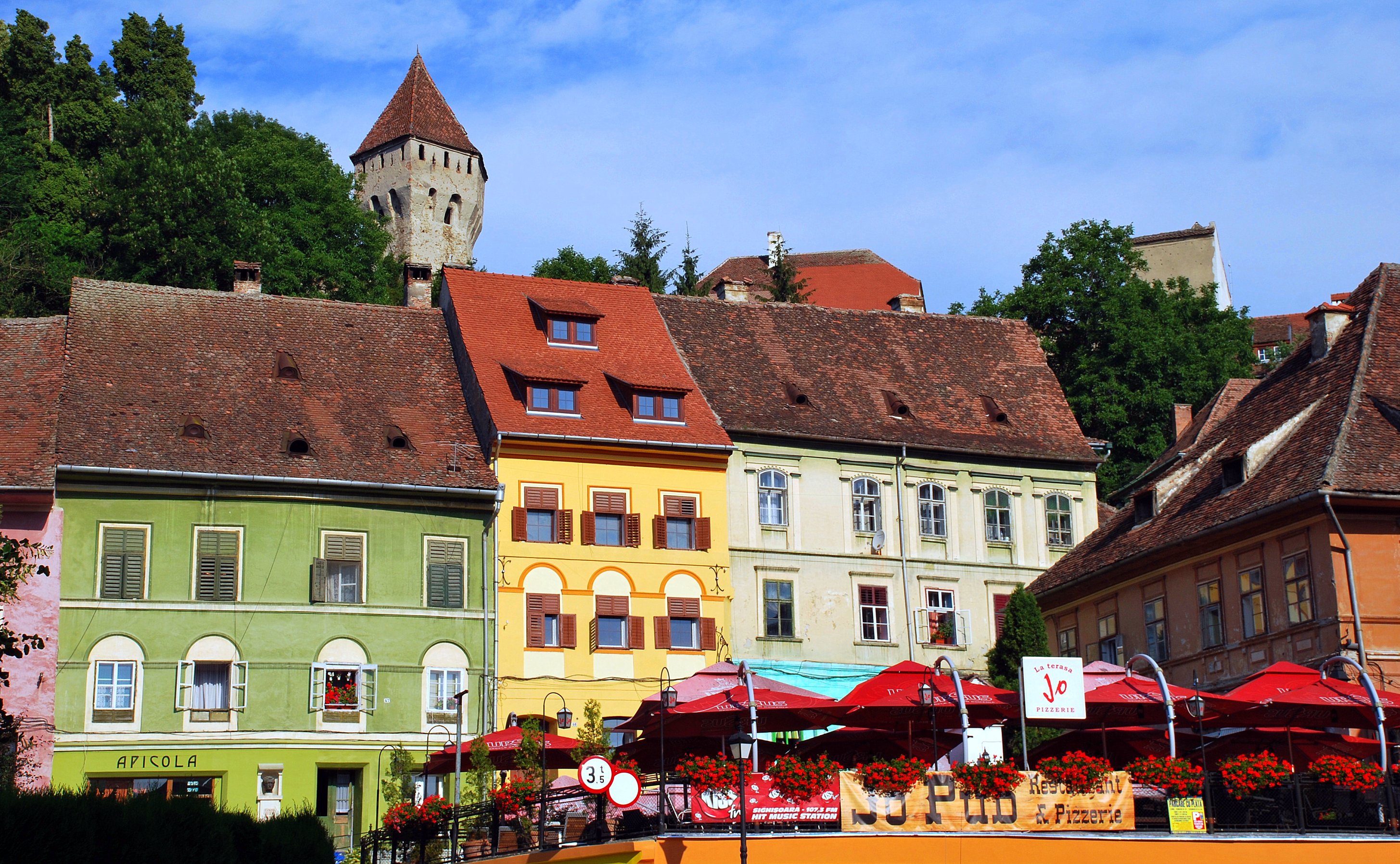
Photo by Eugen Marculescu Creative Commons Attribution-Share Alike 2.0 Generic on Unsplash
Best timeMay-Jun
Suggested stay4-5 nights
Budget from$105/dayPer person, double occupancy
Trip difficultyEasy3/10 overall
Unbeaten score8/10Easy, still overlooked
01 / The pitch
Sighișoara is one of the last inhabited medieval citadels in Europe — not a museum reconstruction, but a living town where people actually hang laundry from Saxon windows and argue about parking on cobblestone streets laid down six centuries ago.
Built by German craftsmen in the 12th century, the Upper Town still feels like a place where time folded in on itself: the Clock Tower dominates Cetății Street, nine surviving towers pierce the skyline, and the covered wooden staircase — the Scholars' Stairs, all 175 steps — climbs steeply to the hilltop Church on the Hill, where you'll find yourself alone with 15th-century frescoes and views across terracotta roofs to the Târnava Mare valley.
What sets Sighișoara apart from Český Krumlov or Rothenburg is that it hasn't been Disneyfied. Yes, Vlad Dracul (father of Vlad the Impaler) was born here in 1431, and yes, there's a restaurant in his alleged birthplace — but the town refuses to lean too hard into the vampire shtick. Instead, you get something rarer: a UNESCO-protected Saxon fortress that's still a functioning Romanian town of 28,000 people, where the morning market sells proper sheep cheese, not souvenir tat, and where you can stay in medieval merchant houses that smell of old wood and stone.
The town works on two levels, literally. The fortified Upper Town is the postcard, with its pastel-colored burgher houses and the annual Medieval Festival each July. But the Lower Town, connected by several stone staircases, is where normal life happens — cafés full of students (there's a university here), the kind of family-run restaurants where the menu is recited, not printed, and streets that empty completely by 9 PM. It's this combination — fairy-tale architecture that you can actually walk through without fighting crowds, plus the rhythms of a real place — that makes visitors feel like they've stumbled onto something protected from the homogenizing forces of mass tourism. For now, anyway.
Photo by Ana Grozea @ Jauntingtrips on Unsplash
Why it's Unbeaten
Out of the main current, in the right way.
Sighișoara sits in the shadow of Transylvania's more famous draw: Brașov and the Bran Castle vampire trail. Most travellers hit those two and move on, missing what is arguably the more authentic medieval experience. This is a working town, not a theme park — locals live in the 16th-century houses, shopkeepers run family businesses from street-level storefronts in the citadel, and the main square still functions as the genuine heart of community life. While Brașov has been heavily polished for tourism, Sighișoara retains a rougher charm and genuine complexity that rewards curious visitors willing to spend two full days here rather than a rushed afternoon.
The main event
What you'll actually do in and around Sighișoara
01
Walk the Citadel walls at dawn or dusk
The 14th-century fortifications are among Romania's best-preserved. Walk the circuit just after sunrise or an hour before sunset when light turns the stone golden and crowds thin. You'll pass the Tailors' Tower, Shoemakers' Tower, and other guild bastions — each tells a story of medieval craft power. This takes 45 minutes and costs nothing.
02
Climb the Church on the Hill (Biserica din Deal)
This 12th-century hilltop church requires a steep walk up 175 steps through a covered wooden staircase that feels genuinely medieval. The interior is sparse but beautiful; the graveyard beyond offers views over the Târnava River valley. Finish by sitting in the courtyard for 20 minutes — it's where locals actually come to think.
03
Explore the covered wooden passages between buildings
Between the main square and the outer walls run narrow covered walkways built into the houses themselves — these were escape routes and trade passages for medieval guilds. They're barely marked on maps and most tourists miss them entirely. Navigate slowly and you'll find small courtyards, forgotten shrines, and the actual rhythm of how the town was built.
04
Visit the Sighișoara Museum (History Museum)
Housed in the Clock Tower, this small but well-curated museum explains the Saxon settlement, medieval guild system, and the town's strategic importance. Climb to the top for panoramic views. The accompanying signage is honest about why the Saxons left post-WWII and what that loss meant for the town's character.
05
Spend an afternoon in the lower town
Most visitors stay in the citadel, but the lower town (below the walls) has genuine life: a traditional market, ordinary shops, and local restaurants where you'll eat alongside construction workers and schoolteachers. It's less romantic but far more real — walk down in late afternoon and buy fresh fruit at the market stalls, then find a spot to watch people.
06
Take a day trip to nearby villages: Criș or Bunești
Buses run to these surrounding Saxon villages where fortified churches still serve agricultural communities. Criș has one of Transylvania's finest examples. These are genuinely untouched — no cafés for tourists, just villages where medieval architecture is simply background to everyday life. Go with low expectations and you'll be rewarded with authentic quiet.
Taste of Sighișoara
Where to eat
Sighișoara's food is straightforward Transylvanian fare — pork-heavy, comforting, and tied to what grows in the surrounding hills. You'll eat well here without pretension: mici (grilled minced meat rolls), ciorbă de burtă (tripe soup), mămăligă (polenta), and generous platters of smoked meats. Most restaurants serve the same menu with minor variations, so consistency is high and surprises are few. Seek out family-run spots where the owner's grandmother cooks in the back rather than restaurants with English menus and tourist prices. Lunch (12–2 p.m.) is the substantial meal; dinner is lighter. Local wine from the surrounding region is cheap and drinkable, though not remarkable.
Casa GurguiatăOccupies a 16th-century house on the main square. Order the ciorbă de burtă and the pork chops grilled over wood — portions are large and flavours are direct and honest. Avoid the overpriced tourist wines; ask for local Târnave white instead. Dinner for two costs around $25–30 with wine.
Taverna SârbuluiA small cellar restaurant serving Serbian-influenced dishes alongside Romanian standards. The grilled meats and sausages are exceptional; the atmosphere is genuinely lived-in rather than decorated-for-tourists. Come after 8 p.m. when locals outnumber visitors and the air fills with cigarette smoke and conversation in Romanian.
02 / The honest read
Is Sighișoara your kind of trip?
Best for
+ History lovers
+ Slow travellers
+ Architecture enthusiasts
+ Cultural explorers
+ Families
Think twice if you want
x Beach seekers
x Nightlife-focused travellers
x Those seeking modern amenities
Effort and reward
Planning
3/5
Physical effort
2/5
Self-reliance
4/5
Scenery
4/5
Culture
5/5
Difficulty breakdown
What "3/10" actually means
Language barrier4/10
English is limited outside main tourist areas; Romanian and German are primary languages.
Logistics3/10
Reachable by bus or train from major cities; town itself is compact and walkable once arrived.
Physical demand2/10
The old town involves some cobbled, uphill walking, but most areas are navigable for average fitness levels.
Infrastructure2/10
Basic but adequate accommodation and dining; some tourist facilities; infrastructure shows age but functions adequately.
Sighișoara is a manageable medieval town experience requiring modest planning and physical effort. Its compact historic centre is walkable, though language and patchy tourist infrastructure demand some independence and flexibility. A 2–3 day visit allows full immersion without rushing.
Read this before booking
The honest caveats
Sighișoara is small and can feel repetitive if you stay more than two days without venturing into the surrounding region. The citadel is genuinely medieval but also genuinely cramped — narrow streets and low doorways mean it feels claustrophobic in summer when tour groups bunch together. The town's post-communist transition is visible in peeling plaster and half-finished renovations on buildings outside the main tourist zone; this gives it character but also means infrastructure (heating, plumbing in budget guesthouses) can be unreliable. Internet is slow in older buildings. The Vlad the Impaler marketing is inescapable and historically dubious — if you're sensitive to tourist mythology masquerading as fact, the constant references will frustrate you. Finally, August is genuinely crowded with day-trippers from Brașov; come in shoulder season (May–early June or September–October) if you want to actually experience the place rather than photograph it.
Safety & health
Sighișoara is one of Transylvania's safest destinations with low violent crime rates. Petty theft and pickpocketing can occur in crowded tourist areas; keep valuables secure. The town and surrounding region are well-policed and visitor-friendly. Healthcare is adequate; public hospitals exist but private clinics offer better standards. No unusual health risks; standard European hygiene applies. Tick-borne encephalitis vaccination recommended if hiking in forests during spring/summer. Travel insurance with medical coverage advised. Tap water is safe; no special water precautions needed.
Official advisoryLevel 1
Exercise normal caution when traveling to Romania; no significant security concerns reported for Sighișoara.
Advisories change. Verify with the US State Department before travelling. Last reviewed: 2025.
03 / Make it real
Plan the trip
May to early June (Spring/Early Summer)
Why go: Flowers bloom on window boxes, light stays until 9 p.m., temperatures 18–22°C (65–72°F) are perfect for walking steep streets. Tourist infrastructure is open but not yet overwhelmed. Local festivals and market activity increase as the season warms.
Watch for: Occasional rain; some smaller guesthouses may not yet be fully open
September to early October (Autumn)
Why go: Harvest season brings activity to the lower town and surrounding villages. Light is particularly beautiful. Temperatures 15–20°C (60–68°F) are ideal for walking. Crowds drop sharply after Labor Day. Wine from the Târnave region is freshly made.
Watch for: Rain becomes more frequent; some days are grey. Season ends abruptly in mid-October as weather deteriorates
July to August (Peak Summer)
Why go: All facilities fully open, longest daylight, warmest temperatures (22–27°C / 72–80°F). Most reliable weather.
Watch for: Heavily crowded with day-trippers, especially weekends. Main square becomes a photograph queue. Prices rise 20–30%. Citadel streets feel genuinely claustrophobic midday. Come for the experience but expect crowds.
Getting there
Getting there
The nearest major airport is Cluj-Napoca (about 150 km northwest), served by European budget carriers and national airlines — from there, a train to Sighișoara takes roughly 3.5 hours. Alternatively, fly into Bucharest's Otopeni (300+ km south) and take the overnight train, which deposits you in Sighișoara early morning. Direct buses run from Brașov (2 hours) and Cluj-Napoca (3.5 hours), which are your best regional hubs. The train station sits at the foot of the old town — a 10-minute walk uphill to the citadel via steep cobbled streets. Book accommodation before arrival; the town is small and fills quickly during summer weekends. Winter train services are reliable but occasionally delayed by snow in the Carpathian foothills.
Visa & entry
Entry requirements
US citizens do not require a visa for temporary tourist and business trips to Romania (Schengen area) not exceeding 90 days during any 180-day period. Your passport must be valid for at least three months beyond your intended departure date. UK and EU citizens, as EU/EEA nationals, enjoy visa-free access to Romania with the same 90-day rule applying within the 180-day Schengen period. Romania became a full Schengen member as of 2025, streamlining border controls for eligible travelers. Non-EU/US visitors should verify specific requirements based on their nationality.
PassportRequirementMax stayDetails
USVisa-free90 days in any 180-day periodPassport must be valid for at least 3 months beyond departure. No visa required for tourism/business trips. Official portal
UKVisa-free90 days in any 180-day periodAs of 2025, Romania is a full Schengen member. UK citizens benefit from visa-free access under reciprocal agreements.
EUVisa-freeUnrestricted for EU/EEA citizensEU/EEA citizens can reside and work without restriction as Romania is an EU member state.
Requirements may change. Confirm with the relevant embassy or official immigration authority before booking.
Daily budget
What it costs once you're there
USD per person/day, double occupancy, excluding international flights (2026-06-16)
Budget$105Includes lodging $20, food $50, activities $25, local transport $10. Lodging anchored to Pension Andrada. medium confidence
Midrange$170Includes lodging $30, food $60, activities $60, local transport $20. Lodging anchored to Central Park Hotel. medium confidence
Splurge$290Includes lodging $40, food $70, activities $130, local transport $50. Lodging anchored to Hotel Fronius. medium confidence
Base yourself well
Where to stay
Search live availability
Use the curated stays below as a starting point, then compare current inventory and prices.
Occupies a sensitively restored Saxon merchant house directly on the main square. Rooms are small but period-appropriate with modern plumbing; the restaurant downstairs serves solid Transylvanian food. Booking early is essential — this place has character and fills months ahead.
Guesthouse$45-70/night
Casa Vlad Dracul
Located in the alleged birthplace of Vlad the Impaler (the historical connection is disputed but the house is genuinely old). Run by a local family, rooms are basic but clean, and you get authentic proximity to the citadel's heart. The host offers useful local knowledge.
Pension/B&B$40-60/night
Pension Andrada
A family-run spot in a quieter part of the old town with exposed stone walls and genuine hospitality. Breakfast is substantial and homemade. Less polished than the hotels but genuinely welcoming and better value.
Hotel$55-90/night
Central Park Hotel
Modern, functional mid-range option just outside the citadel proper. Less atmospheric than staying in the old town itself, but convenient if the medieval guesthouses are full, and prices are fairer for what you get.
Language, useful phrases, and cultural notes +
Romanian / English: Moderate
Some English spoken in tourist areas, hotels, and restaurants - limited elsewhere. Translation app useful as a backup
Romanians value politeness and formality; greet with handshakes and use titles (Domnul/Doamna) until invited to use first names. Sighișoara's Saxon heritage is integral to local identity—respect references to German history and architecture. Tipping is customary (10%) but not obligatory in restaurants.
HelloBunăBOO-nuh
Thank youMulțumescmool-tsoo-MESK
How much?Cât costă?kuht KOS-tuh
Where is...?Unde este...?OON-deh ES-teh
Excuse meScuzați-măskoo-zaht-see-MEH
04 / Keep going
Nearby & beyond
1 hour by car
Brașov
Medieval Saxon town with dramatic mountain backdrop and well-preserved old town centre.
45 minutes by car
Mediaș
Another fortified Saxon settlement with wine-making heritage and quieter medieval streets.
1.5 hours by car
Biertan Fortified Church
UNESCO-listed hilltop church exemplifying Saxon ecclesiastical architecture and defensive design.