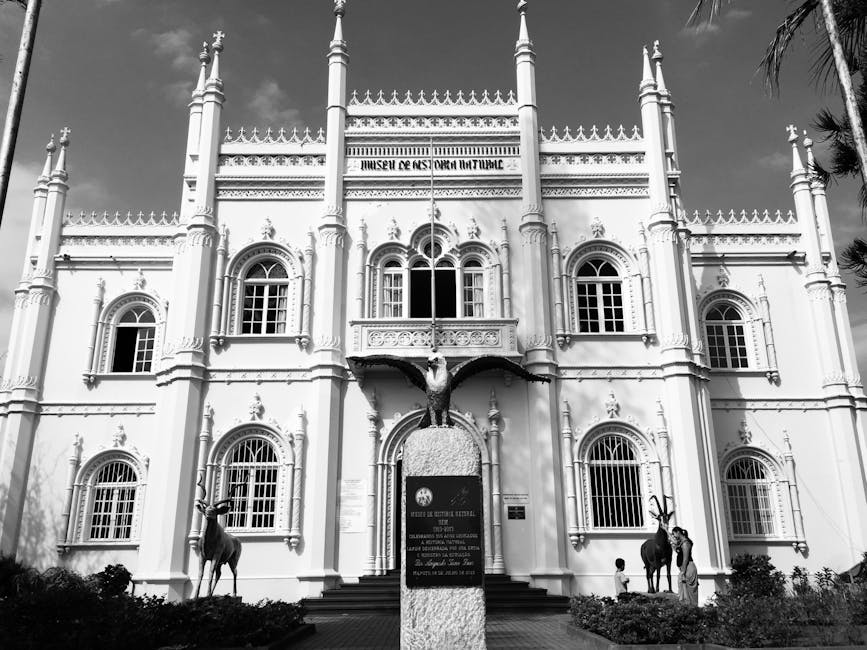
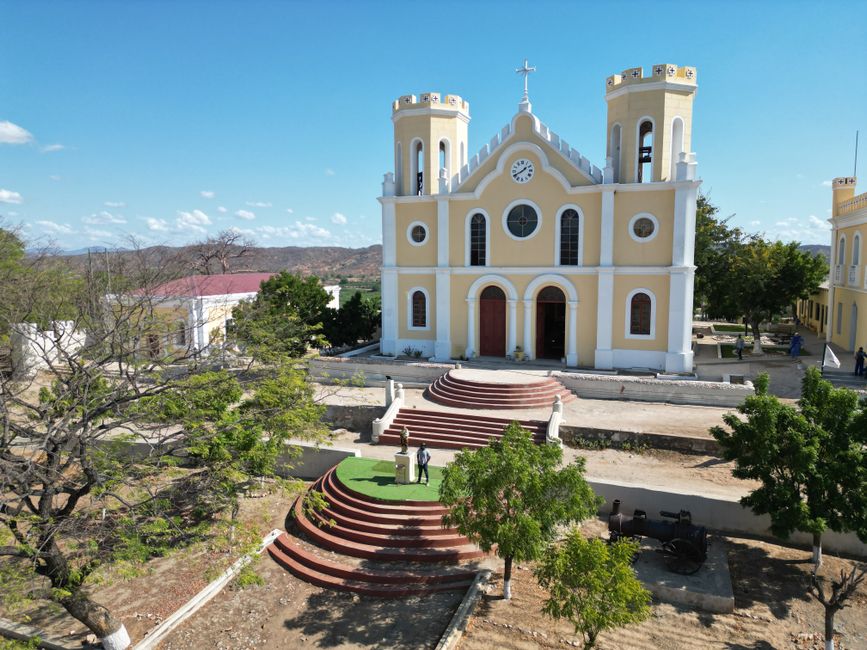
Ilha de Moçambique sits three kilometers off the northern mainland, a sliver of coral limestone barely two kilometers long where Vasco da Gama once anchored and four centuries of Swahili, Portuguese, Indian, and African histories have fused into peeling lime-washed walls and crumbling colonnades.
The Stone Town in the north island holds the Chapel of Nossa Senhora de Baluarte—the oldest European building in the southern hemisphere—while the Palace of São Paulo now houses a museum where you can stand on the same verandah where Portuguese governors watched dhows arrive from Goa and Zanzibar. Walk down Rua dos Arcos and you'll pass children playing football beside fortresses built to protect the gold and ivory routes, while grandmothers in capulanas sell grilled barracuda caught that morning.
The island is a UNESCO World Heritage Site, though you'd never guess it from the lack of velvet ropes or ticket queues. Most visitors stay in converted colonial mansions like Casa Branca or O Escondidinho, where breakfast might include fresh papaya, coconut bread, and stories from hosts who chose to restore these buildings rather than let them sink into the Indian Ocean. The southern Makuti Town, where the majority of the island's 14,000 residents live in palm-thatch houses and winding alleyways, reveals the living culture that the Stone Town's monuments only hint at—dhow builders still work using techniques unchanged for centuries, and the rhythm of the island follows tides and fishing cycles rather than tour buses that don't come here anyway.
Travelers who make it to Ilha de Moçambique—a seven-hour drive from Nampula followed by a rickety bridge crossing—consistently describe it as one of Africa's most affecting destinations precisely because it isn't preserved in aspic for tourists. The island is poor, infrastructure is minimal, and the sense of being at a place that matters profoundly to history while remaining unknown to most of the traveling world creates an intimacy that manicured heritage sites can never replicate. You eat matapa and grilled prawns at informal restaurants facing the fort walls, swim off empty beaches while watching dhows tack past, and realize you're experiencing something that won't exist in this form much longer.
Photo by SINAL Multimédia on Pexels
Why it's Unbeaten
Out of the main current, in the right way.
Ilha de Moçambique exists in that peculiar sweet spot where history is so dense it feels almost unreal, yet the island remains largely absent from mainstream travel guides. Most visitors to Mozambique either skip the country entirely due to safety concerns, or they head straight to the beach resorts of Bazaruto and Inhaca further south. The island—a UNESCO World Heritage Site—gets overshadowed by more publicized (and more accessible) Portuguese colonial sites in Angola and Cape Verde. What they're missing is one of the last places in southern Africa where you can walk through centuries-old stone buildings, watch fishermen use traditional methods virtually unchanged since the 1500s, and experience genuine island life without the infrastructure of mass tourism.
The main event
What you'll actually do in and around Ilha de Moçambique
01
Walk through the Stone Town (Cidade de Pedra)
The heart of the island is a labyrinth of narrow streets lined with centuries-old Portuguese, Arab, and Indian architecture—some beautifully maintained, some romantically decaying. Spend at least a full morning wandering without a specific route; you'll stumble into hidden courtyards, tiny shops selling fish and rice, and local homes where life happens at a wonderfully slow pace. The architecture tells the story of trade routes and empires without needing a guidebook.
02
Visit the Chapel of Nossa Senhora de Baluarte and Fort of São Filipe
These 16th-century structures are among the oldest European buildings in sub-Saharan Africa. The fort's thick walls and bastions are remarkably intact, and the views from the top sweep across the channel to the mainland. The chapel is still used for services—if you're here on a Sunday, the singing echoes through the stone in a way that feels transportive.
03
Witness traditional dhow fishing at sunrise
Hire a local guide (they'll find you) to wake before dawn and watch fishermen launch their traditional wooden dhows using methods unchanged for centuries. The golden light, the rhythmic chanting, the simple power of human skill against the ocean—it's meditative and genuinely moving. You can arrange to go out on the water if you're comfortable with basic boats.
04
Explore the Museum of Sacred Art (Igreja da Misericórdia)
A small but haunting collection of religious artifacts, sculptures, and vestments housed in a restored church. It's intimate, rarely crowded, and the caretaker often gives impromptu tours with real passion for what he's protecting. Some pieces date back to the Portuguese conquest; others show the blending of African and European spiritual traditions.
05
Snorkel or dive the nearby reefs
The waters around the island and nearby cays hold colorful coral reefs and an impressive array of tropical fish. Several operators offer half-day trips; the reefs are healthy and less picked-over than more touristy destinations. Visibility is best in the dry season (May–September).
06
Take a sunset boat ride to nearby cays
Local boatmen can take you to small, uninhabited sand islands nearby for swimming, beachcombing, and spectacular golden-hour light. It's simple, it's cheap, and it offers that rare sense of having the landscape entirely to yourself. Bring water and sunscreen.
Taste of Ilha de Moçambique
Where to eat
Island food is about freshness and simplicity: whatever came from the ocean that morning, paired with rice, cassava, or coconut. Expect grilled fish prepared with lime, garlic, and chili; prawns when in season; and occasional crab. The culinary tradition here blends Portuguese, Arab, and East African influences—you'll taste it in the spice choices and cooking methods. There are no fancy restaurants, which is the point. Most guesthouses can arrange meals with advance notice, and there are a few simple spots dotted through town that cater to locals first, tourists second.
Casa do Capitão (dining room)The guesthouse serves dinner by reservation only—usually grilled fish caught that day, with rice and fresh salad. The meal is intimate, unhurried, and often shared with other guests. The owner has a gift for sourcing the best of what's available and preparing it without fuss.
Beachfront grills near the harborWalk along the waterfront in late afternoon and you'll find local women grilling fresh fish over charcoal. Point to what you want, negotiate a price (usually very cheap), and eat it seasoned simply with lime and chili. Sit on the sand, watch the boats, and understand why you came here.
Ponta do Ouro Lodge (restaurant)The guesthouse serves dinner featuring whatever the day's catch was, prepared Portuguese-style with good wine pairings available. The rooftop setting is unbeatable at dusk, and the food is honest rather than fussy—exactly what island cooking should be.
02 / The honest read
Is Ilha de Moçambique your kind of trip?
Best for
+ History enthusiasts
+ Cultural explorers
+ Photographers
+ Off-the-beaten-path seekers
+ Architecture lovers
Think twice if you want
x Families with young children
x First-time Africa travelers
x Those requiring reliable infrastructure
x Beach resort seekers
Effort and reward
Planning
4/5
Physical effort
2/5
Self-reliance
4/5
Scenery
4/5
Culture
5/5
Difficulty breakdown
What "7/10" actually means
Language barrier7/10
Portuguese is essential for meaningful interaction; English is rarely spoken outside the occasional hotel, making a phrasebook or translation app very useful.
Logistics7/10
Getting to the island requires multiple transport connections through Nampula, and schedules are unreliable — expect delays and plan for flexibility.
Physical demand4/10
The island is small and flat, easily explored on foot, though the tropical heat and humidity can be exhausting during midday.
Infrastructure5/10
Power outages are common, water supply can be intermittent, and ATMs frequently run dry — but accommodation options range from basic to charming restored colonial buildings.
Ilha de Moçambique rewards patient, adaptable travelers with one of Africa's most atmospheric historical destinations. The challenges lie not in physical demands but in logistics — unreliable transport, limited English, and basic infrastructure require flexibility and advance planning. Those who embrace the slower pace and prepare accordingly will discover an unforgettable UNESCO World Heritage site largely untouched by mass tourism.
Read this before booking
The honest caveats
Let's be direct: this is not a comfortable destination for travellers accustomed to certainty and convenience. The ferries run when they run (not on a fixed schedule). Internet is spotty. The island has no ATM, so bring cash from Nampula in meticais or South African rand. Medical facilities are basic—if you have a serious health issue, you'll need to get to Nampula or further. The heat and humidity can be intense. Some buildings are genuinely unsafe; stick to marked areas and use local guidance. Perhaps most importantly: Mozambique as a whole carries legitimate security concerns in northern provinces. While Ilha de Moçambique and the southern approach via Nampula are generally considered safer than Cabo Delgado, the U.S. and Canadian governments maintain travel advisories for the country. This is not a place to travel carelessly or dismiss safety planning. If you're uncomfortable with any level of unpredictability, limited medical infrastructure, or need constant reassurance from Wi-Fi and running water, this island will frustrate you.
Safety & health
Ilha de Moçambique itself is generally safe and has a relaxed, small-town atmosphere where crime is uncommon. However, the US State Department rates Mozambique at Level 2 (Exercise Increased Caution) due to health issues, crime, civil unrest, and terrorism. The northern Nampula Province has areas rated Level 4 (Do Not Travel) due to terrorism concerns, though Ilha de Moçambique is not in these affected districts. Petty theft can occur — keep valuables secure and avoid displaying expensive items. Travel between Nampula and the island should be done during daylight hours.
Malaria is endemic throughout Mozambique, including Ilha de Moçambique. Prophylaxis is strongly recommended, along with mosquito repellent, long sleeves at dusk, and sleeping under treated nets. Ensure routine vaccinations are up to date, and consider hepatitis A, hepatitis B, typhoid, and rabies vaccines. Yellow fever vaccination is required if arriving from endemic areas. Tap water is not safe to drink — stick to bottled or purified water.
Medical facilities on the island are extremely limited. The nearest hospital with reasonable capabilities is in Nampula, about 3 hours away. Travelers should carry a comprehensive first aid kit, any prescription medications needed, and have evacuation insurance. In case of serious illness or injury, medical evacuation to South Africa may be necessary.
Official advisoryLevel 2
Exercise increased caution due to crime, civil unrest in some regions, and limited medical facilities.
Advisories change. Verify with the US State Department before travelling. Last reviewed: 2025.
03 / Make it real
Plan the trip
Dry Season (May–October)
Why go: Sunny, warm days with low humidity. Seas are calmer and visibility excellent for water activities. This is peak season, so the island has more visitors and bustle, but it's still genuinely quiet compared to mainstream destinations. Accommodation is more likely to be available.
Watch for: Slightly cooler at night (though still warm). Tourism infrastructure is at its peak, so prices are highest. If you're seeking solitude, this isn't it.
Green Season (November–February)
Why go: The island is lush, dramatically green. Fewer tourists mean more genuine interactions with locals. Accommodation rates drop noticeably. If you can tolerate heat and humidity, you'll have a more intimate experience of island life.
Watch for: Heavy rainfall is possible (January–February especially), which can disrupt boat schedules and ground you on the island. Heat and humidity are intense. Water visibility for snorkeling declines. Some facilities reduce hours or close temporarily.
Shoulder Season (March–April, September–October)
Why go: A middle ground: reasonably dry weather, smaller crowds than peak season, moderate prices. September–October is particularly good—the island is transitioning to dry season without the peak-season density.
Watch for: Rain remains possible in March–April. October can be very hot and dusty. Fewer organized tours may be operating compared to peak season.
Getting there
Getting there
Your gateway is Nampula, Mozambique's third-largest city, which has a functioning airport receiving flights from Maputo (1.5 hours) and Johannesburg (3+ hours with connections). From Nampula airport, it's a 2.5-3 hour drive north to the town of Mossuril, where you'll catch a ferry or motorboat across the shallow channel to the island itself (15-30 minutes depending on conditions and tide). The road to Mossuril is paved but deteriorates the closer you get to the coast; hiring a driver through your accommodation is safer and more reliable than attempting to rent a car independently. Note: transport on the island itself is entirely by foot or occasional bicycle—embrace this, it's part of the magic. Accommodation hosts can typically arrange your boat transfer in advance.
Visa & entry
Entry requirements
US, UK, and EU citizens require a visa to enter Mozambique. Visas can be obtained in advance from Mozambican diplomatic missions or, in some cases, on arrival. The process typically takes 5-10 business days if applying beforehand, though processing times can vary. Most visitors receive a tourist visa valid for 30 days upon entry, with the possibility of extension if needed. It is strongly recommended to obtain your visa before arrival, as on-arrival services may not always be available and can involve additional hassles.
PassportRequirementMax stayDetails
USVisa Required30 daysVisa on arrival may be available but is not guaranteed; advance application is recommended. Official portal
UKVisa Required30 daysApply in advance through the High Commission; on-arrival visas are possible but not guaranteed. Official portal
EUVisa Required30 daysEU citizens should apply at their nearest Mozambican embassy; multiple entry visas are available for longer stays. Official portal
Requirements may change. Confirm with the relevant embassy or official immigration authority before booking.
Daily budget
What it costs once you're there
USD per person/day, double occupancy, excluding international flights (2026-06-16)
Budget$80Includes lodging $15, food $20, activities $25, local transport $20. Lodging anchored to Ponta do Ouro Lodge. medium confidence
Midrange$165Includes lodging $15, food $40, activities $60, local transport $50. Lodging anchored to Ponta do Ouro Lodge. medium confidence
Splurge$350Includes lodging $60, food $70, activities $130, local transport $90. Lodging anchored to Pestana Inhaca Island Lodge. medium confidence
Base yourself well
Where to stay
Search live availability
Use the curated stays below as a starting point, then compare current inventory and prices.
A simple, Portuguese-owned guesthouse on the island's quieter eastern tip with views across to the mainland. Rooms are clean and basic, but the real draw is the owner's deep knowledge of island history and connections to local guides. The rooftop is perfect for sunset drinks and stars—something the island does very, very well.
Boutique resort$120-200/night
Pestana Inhaca Island Lodge
This isn't on Ilha de Moçambique itself, but it's the area's main upscale option (on nearby Inhaca Island, 30 minutes by boat). Excellent for comfort-seekers who want organized activities, good dining, and reliable infrastructure without sacrificing the sense of remoteness.
Heritage guesthouse$50-90/night
Casa do Capitão
A restored 18th-century captain's house in the Stone Town, now run as a small hotel with period furniture and thoughtful restoration. You're literally sleeping in history here—thick walls, high ceilings, and the kind of character you can't manufacture. Hosts offer evening conversations about the island's past over tea.
Beach bungalow lodge$35-70/night
Coral Lodge Mozambique
Modest beachfront bungalows on the island's south end with direct sand access and reliable management. Good mid-range option if you want water views without the price tag of Pestana, though less character than the Stone Town guesthouses.
Language, useful phrases, and cultural notes +
Portuguese / English: Basic
Simple tourist phrases only in hotels and main attractions - most locals speak no English. Translation app strongly recommended
Ilha de Moçambique has a unique blend of African, Arab, Indian, and Portuguese influences visible in its architecture, food, and customs. Modest dress is appreciated, especially when visiting mosques or churches — cover shoulders and knees. Greetings are important; take time to say hello before conducting any business. The island moves at a slow pace, so embrace the relaxed atmosphere rather than rushing.